When the Cleveland Browns chose quarterback Johnny Manziel with the 22nd pick in the 2014 NFL Draft, they were probably thinking they had just secured success for future seasons. This was deemed the best decision based on what the coaching staff, scouts, and upper management had witnessed of Manziel’s collegiate performance. Flash forward one year: Due to lack of consistency of his play and off-field issues, Manziel was dropped by the team at the end of the 2015 season.

What if there was a way for the Cleveland Browns to avoid this outcome? An improvement in the assessment of talent and future value of current and future NFL players that could aid in teams making the best personnel decisions. Sports analytics is the highly sought tool for improvement and its use has been rising in the NFL.
The goal of this post is to show why every NFL team owner should utilize sports analytics to make decisions on what players to draft or what players to acquire in free agency or trade.
What is Sports Analytics?
In an interview published in a peer-journal titled Ubiquity, Dr. Dave Schrader described sports analytics as the science of gathering data about teams and players to conduct analysis to create insights that will improve sports decisions. Some examples of the decisions teams will have to make are on which players to recruit, how much to pay players, how to train and keep players healthy, and when is it time to move on from a player.
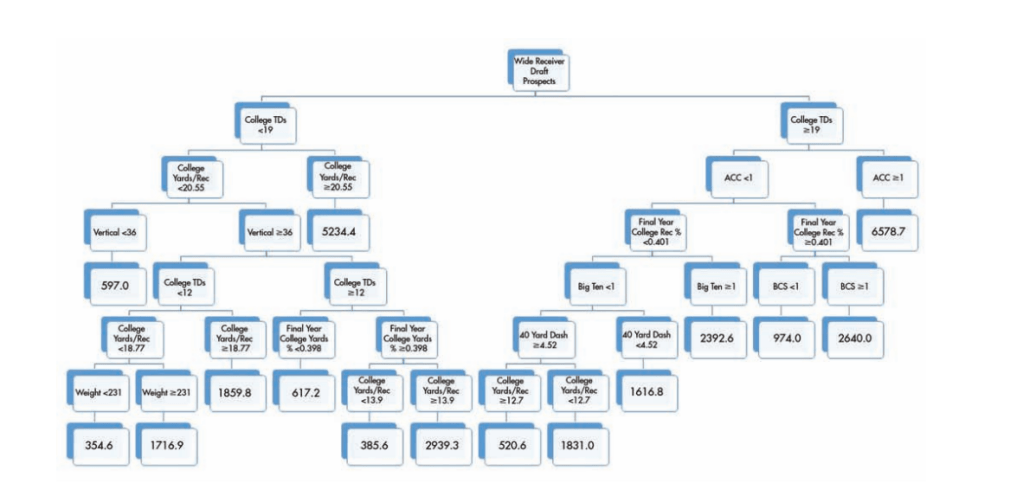
The process often involves making a decision tree or a regression model in order for the data to be analyzed and predictions can be made about a player or a team. A decision tree is similar to a flowchart where a node represents a decision or attribute and each branch represents the corresponding outcome of that node.
The image below shows an example of a decision tree that predicts the future success of wide receiver draft prospects based on statistics and attributes of each player that was found to be statistically significant. Some examples of these data points are the university that they attended, the number of touchdowns they scored in college, and the player’s forty yard dash time.
One of the trending uses of sports analytics in the NFL focuses on talent acquisitions. This describes the process of teams assessing the future value and performance of players, which will drive the decision on whether to draft, sign as a free agent, or trade for a player.
In an article on Wired, the author shares statements from Ray Hensberger, the Director of Sports Analytics at the consulting firm Booz Allen Hamilton, about how sports analytics can be used to create a risk profile for a player. The process combines data on injury history, practice performance, and game performance in order to see the trends of a player over the course of a season or career. This process would improve how teams treat free agency because there is a transition from making decisions on what a player has done in the past to making decisions or predictions of what that player can do in the future.
Traditional Method of Scouting and Assessing Players
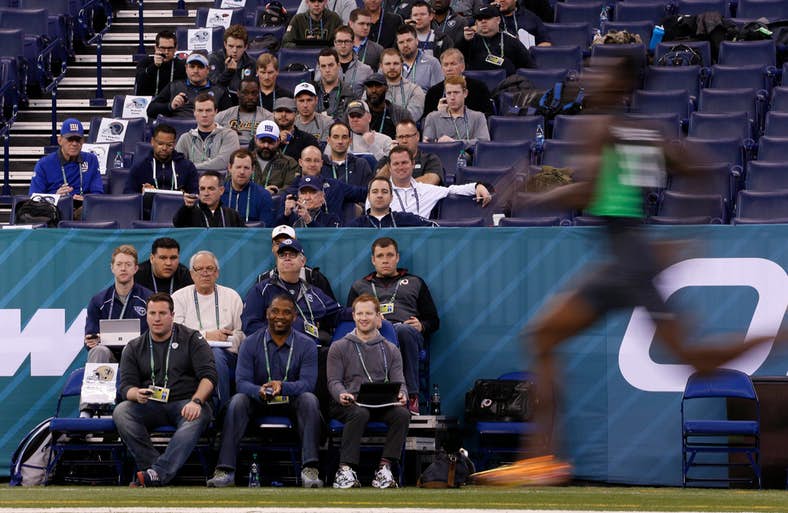
The traditional method of assessing whether a player should be acquired by a team involves the practice of having coaching staff or scouts watch each potential recruit perform in a game or practice and create their own judgement based on what they have seen from successful players in the past. This is common practice, especially before the NFL Draft, which led to the creation of the NFL Combine. This annual event brings together the top college football prospects to practice for scouts from every team. The image below shows a picture of scouts evaluating a player at the combine.
The traditional method is still a commonly used practice for NFL teams as evident from the Los Angeles Sentinel’s report on a press conference with Tom Telesco, the General Manager of the Los Angeles Chargers, who discusses how the Chargers have eight college scouts that travel the country to attend practices and games to create draft reports that will be used for the team to make decisions.
Some teams have had plenty of success with this method and chose players that changed their franchises for the better, but some have also made decisions that put their team in a hole for multiple years.
A research article published in the European Journal of Sports Science, analyzed the traditional selection procedures and found that one of the flaws of this method was that the impression scouts may be affected by personal biases. The scout’s ability to assess talent also plays a large role in their judgement, which could lead to errors in making decisions.
Sports analytics has the capability of minimizing human error through objective predictions of the future value of players.
Improved Decision Making from Sports Analytics
The same article from the European Journal of Sports Science, analyzed an actuarial approach that involved predictions based on a predefined scoring system similar to how sports analytics is conducted. What the authors found was that the actuarial approach often lead to superior performance predictions compared to the traditional method because there is no human bias and instead involves an objective judgement criteria.
Sports analytics is another objective approach to assessing the future value of players. It also emphasizes a player’s performance in their own unique sports environment over a test in a controlled setting, like the NFL Combine or a scout attending a random practice.
One example of this process is described in a research article in the peer-reviewed journal CHANCE, where regression analysis and a decision tree was used to predict the NFL performance of wide receivers and tight ends prospects for the 2015 NFL Draft.
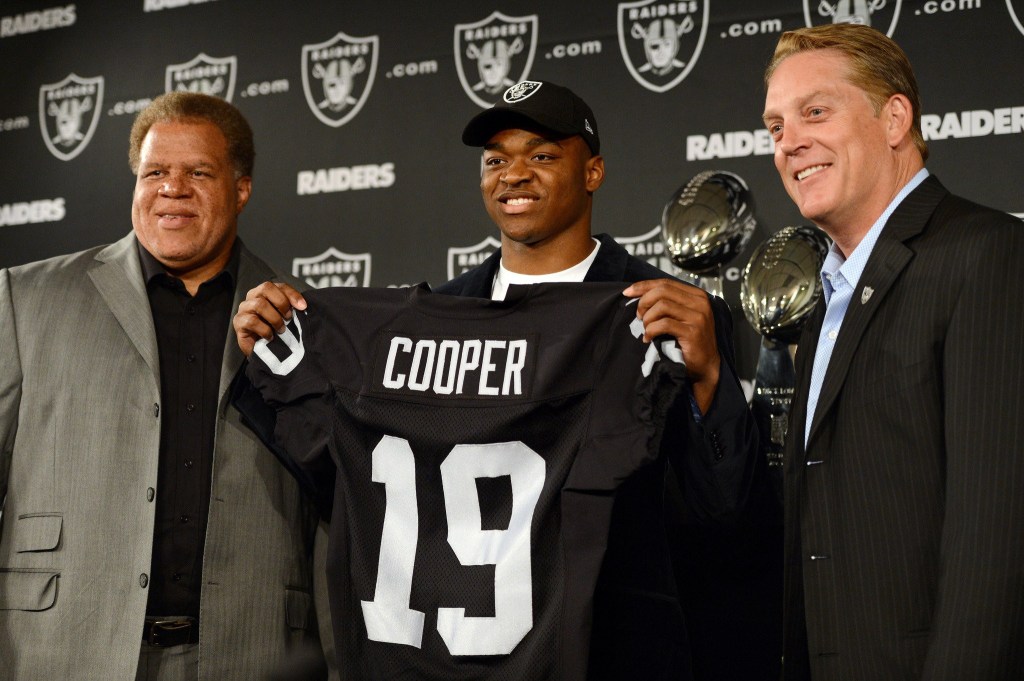
By applying statistical thinking to data for players who entered the NFL between 1999 and 2013, they found the best predictors of future NFL success and made some predictions about the wide receivers drafted in the 2015 NFL Draft. One of the predictions of their model was that of the six wide receivers drafted in the first round Amari Cooper (shown in the image above) was projected to be the best and he was ranked the fourteenth best wide receiver in the NFL Top 100 for 2019. Davante Adams was also projected, who was drafted in the second round, to perform well and he was ranked the eighth best in the same list.
Sports analytics has the capability of making reliable predictions and evaluations of the future value and performance of players. As the NFL collects more data, the models and predictions from sports analytics will only get better and teams will not have to worry as much about making the wrong decision on which players to acquire.
Does this mean that all teams should abandon the traditional method of scouting players and go all in on analytics? Absolutely not. An article in Sports Illustrated about the NFL and the use of analytics summed it up perfectly in that sports analytics should be a supplement to the evaluation.
Sports analytics is an emerging method of making strong predictions of the future value and performance of players. The traditional method alone has its errors, so when sports analytics are added in the decision-making process then a team has better chances of creating success for their team. If all NFL teams implement sports analytics into their organization then not only will their team improve, but the game itself and the league as a whole will improve.
 Tim's Sports Analytics Blog